Newer
Vague Expressions ④: How to Use 「〜のようです」
02/19/2026

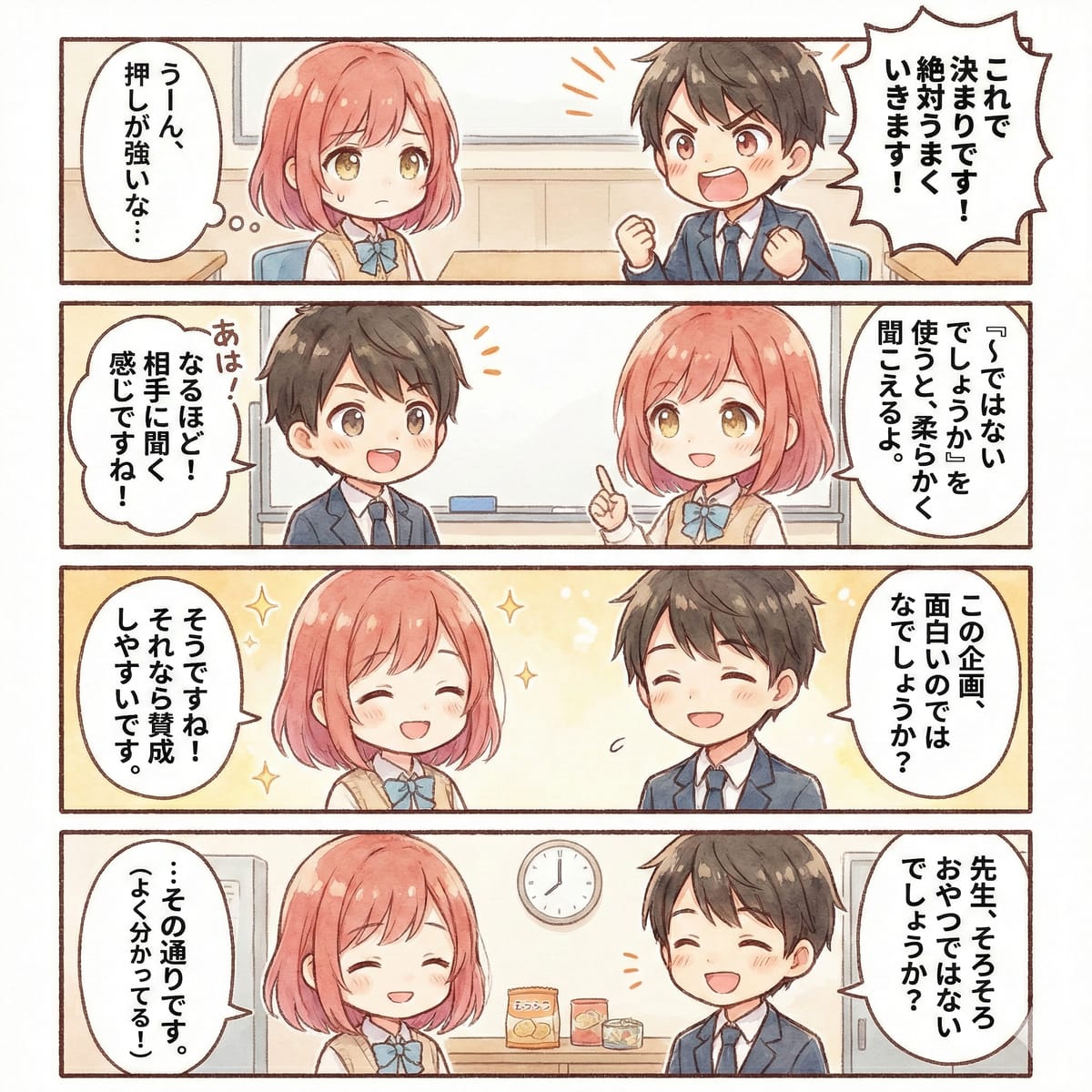
「〜ではないでしょうか」 helps you share ideas with care for the other person.
Because it does not sound final, it feels like a soft suggestion.
At the same time, if the usage is wrong, it can sound:
So today, we will learn when to use it and how to rephrase it together.
「〜ではないでしょうか」 has these functions:
It is common in meetings, class discussions, and everyday consultations.
You can include the feeling of "What do you think?" inside one sentence.
| Wording | How it sounds |
|---|---|
| 「〜です。」 | Clear judgment, close to a decision. |
| 「〜と思います。」 | The speaker's opinion is shown. |
| 「〜ではないでしょうか。」 | A suggestion that asks for agreement. |
These two are close in meaning, but their focus is different.
「この方法がよいと思います。」 (I think this method is good.)
「この方法がよいのではないでしょうか。」 (Wouldn't this method be good?)
「〜ではないでしょうか」 gives the other person time to think and respond.
That makes it very useful in discussion scenes.
You can make 「〜ではないでしょうか」 with noun, adjective, and verb sentences.
The basic pattern is to add 「ではないでしょうか」 after a normal sentence.
| Sentence type | Form | Example |
|---|---|---|
| Noun | Noun + 「ではないでしょうか」 | 「この案が最善ではないでしょうか。」 (Wouldn't this plan be the best?) |
| i-adjective | i-adjective + 「のではないでしょうか」 | 「この説明は長いのではないでしょうか。」 (Isn't this explanation long?) |
| na-adjective | na-adjective + 「なのではないでしょうか」 | 「この手順は安全なのではないでしょうか。」 (Isn't this process safe?) |
| Verb | Plain form + 「のではないでしょうか」 | 「先に確認したほうがよいのではないでしょうか。」 (Wouldn't it be better to check first?) |
Adding 「の」 often makes the sentence sound more natural.
In casual speech, people may use forms close to 「〜んじゃないですか」, but in this article we use polite forms.
Use it in meetings or consultations when you want to respect the other person's position.
The second version helps because:
It also works for checking and aligning ideas.
If you say 「あります」 directly, the atmosphere can become hard to challenge.
With 「〜ではないでしょうか」, the other person can share reasons more easily.
For example:
Both lines create an entry point for discussion.
This expression is useful, but using it in every sentence can have the opposite effect.
Especially in these scenes:
In those cases, choose a clearer sentence.
| Fits | Does not fit |
|---|---|
| When making proposals | When giving a final decision |
| Early stage of opinion exchange | When clear instructions are needed |
| When you want to hear the other person's view | When immediate action is required |
| Early phase of consensus building | When responsibility must be explicit |
It is important to switch between soft forms and direct forms by situation.
Adjust sentence strength by your purpose.
| Rephrase type | Goal | Japanese example | Reading (kana(かな(ひらがなよみ))) | Pronunciation (IPA) | Function |
|---|---|---|---|---|---|
| Suggest and seek agreement | Make a soft proposal | 「この案がよいのではないでしょうか。」 (Wouldn't this plan be good?) | (この あん が よい の では ない でしょうか) | [ko̞no̞ aɴ ɡa̠ jo̞i no̞ de̞wa nai de̞ɕoːka] | Leaves room for response |
| State your opinion | Show speaker stance | 「私はこの案がよいと思います。」 (I think this plan is good.) | (わたし は この あん が よい と おもいます) | [wataɕi wa ko̞no̞ aɴ ɡa̠ jo̞i to̞ o̞mo̞imasɯ] | Clarifies whose opinion it is |
| Raise an issue softly | Check without confrontation | 「この点は問題があるのではないでしょうか。」 (Might there be a problem at this point?) | (この てん は もんだい が ある の では ない でしょうか) | [ko̞no̞ te̞ɴ wa mo̞ɴdai ɡa̠ aɾɯ no̞ de̞wa nai de̞ɕoːka] | Makes disagreement easier |
| State a fact clearly | Communicate judgment | 「この点は問題があります。」 (There is a problem at this point.) | (この てん は もんだい が あります) | [ko̞no̞ te̞ɴ wa mo̞ɴdai ɡa̠ aɾimasɯ] | Good when quick action is needed |
| Use another polite proposal | Invite participation | 「まずA案から試すのはどうでしょうか。」 (How about trying Plan A first?) | (まず えーあん から ためす の は どう でしょうか) | [mazɯ eːaɴ kaɾa tame̞sɯ no̞ wa doː de̞ɕoːka] | Makes it collaborative |
| Announce a decision | Make conclusion clear | 「今日はこの案で進めます。」 (We will proceed with this plan today.) | (きょう は この あん で すすめます) | [kʲo̞ː wa ko̞no̞ aɴ de sɯsɯmemasɯ] | Moves the discussion forward |
IPA is approximate. Vowel length and the sound of 「ん」 change a little by speaker. Check with kana too.
Even with the same message, changing the sentence by scene improves communication.
| Scene | Intention | Better wording | Reading (kana(かな(ひらがなよみ))) | Pronunciation (IPA) | Point |
|---|---|---|---|---|---|
| Daily life (family planning) | Make a soft proposal | 「明日は朝に出るほうがよいのではないでしょうか。」 (Wouldn't it be better to leave in the morning tomorrow?) | (あした は あさ に でる ほう が よい の では ない でしょうか) | [aɕita wa asa ni de̞ɾɯ hoː ɡa̠ jo̞i no̞ de̞wa nai de̞ɕoːka] | Easier for others to disagree politely |
| School (group presentation) | Confirm group agreement | 「この順番で説明するのがよいのではないでしょうか。」 (Wouldn't this order be good for explaining?) | (この じゅんばん で せつめい する の が よい の では ない でしょうか) | [ko̞no̞ dʑɯmba̠ɴ de̞ se̞tsɯme̞ː sɯɾɯ no̞ ɡa̠ jo̞i no̞ de̞wa nai de̞ɕoːka] | Good starting point for consensus |
| Work (meeting) | Raise a concern | 「この予定は少しきびしいのではないでしょうか。」 (Isn't this schedule a little tight?) | (この よてい は すこし きびしい の では ない でしょうか) | [ko̞no̞ jo̞te̞ː wa sɯko̞ɕi kʲibiɕiː no̞ de̞wa nai de̞ɕoːka] | Softens possible conflict |
| Work (final decision) | Give a clear conclusion | 「今日はこの案で進めます。」 (We will proceed with this plan today.) | (きょう は この あん で すすめます) | [kʲo̞ː wa ko̞no̞ aɴ de sɯsɯmemasɯ] | Switch to decisive wording |
| Daily life (with friends) | Propose and check together | 「先にチケットを買うのがよいのではないでしょうか。」 (Wouldn't it be better to buy tickets first?) | (さき に ちけっと を かう の が よい の では ない でしょうか) | [sakʲi ni tɕike̞tːo o̞ kaɯ no̞ ɡa̠ jo̞i no̞ de̞wa nai de̞ɕoːka] | Gently encourages action |
| Work (instruction) | Clarify required action | 「先に資料を送ってください。」 (Please send the documents first.) | (さき に しりょう を おくって ください) | [sakʲi ni ɕiɾʲoː o̞ o̞kɯtːe̞ kɯda̠sai] | Best when quick action is needed |
If you decide your purpose first, picking the right form gets easier.
One short reason helps the listener decide.
If you keep soft proposal forms all the way, the conclusion can disappear.
Close with a decision sentence so the next action is clear.
| Common sentence | What is the issue? | Fix (example) |
|---|---|---|
| 「この案で進めるのではないでしょうかでしょうか。」 | 「でしょうか」 is repeated | 「この案で進めるのではないでしょうか。」 |
| 「今日は中止ではないでしょうか。」 | Too weak in a decision scene | 「今日は中止です。」 |
| Using 「〜ではないでしょうか」 for everything | Hard to see the conclusion | Use 「〜ではないでしょうか」 for proposals and 「〜です」 for decisions |
「〜ではないでしょうか」 is useful for:
But if you overuse it, it can sound:
So switch by scene: