Newer
Rephrase Your Words ⑦ How to rephrase 「〜と思います」
14/12/2025

“すごい” appears everywhere in conversation.
We hear “すごい人”, “すごくおいしい”, “すごいですね!” to show surprise, awe, or praise.
But because it is so convenient, it can be hard to know what exactly is “すごい” and in what way.
Here we sort “すごい” by function and pick alternatives that fit the goal.
To keep it friendly for new learners, we use short, upbeat sentences.
“すごい” originally meant “frightening; very large in degree.”
Today it is often positive, but depending on context it can express approval, disapproval, surprise, or strong feeling.
| Use | Meaning | Example | How it comes across |
|---|---|---|---|
| Emphasizing degree | Very ~ | 「すごく寒いです」 (It’s very cold.) | Only the strength of temperature is told |
| Praise | Excellent | 「すごい技術ですね」 (That’s great skill.) | Used when you want to compliment |
| Surprise / awe | Unexpected and impressive | 「すごい!できたんですか?」 (Wow, you did it?) | Emotion is in focus |
| Negative intensity | Too strong / problematic | 「すごい音がする」 (The noise is loud.) | Shows discomfort or trouble |
Even with the same “すごい,” the function changes by situation.
When you rephrase, decide first “what,” “how much,” and “with what feeling” you want to say.
Clarify the kind of feeling or evaluation you want to show, then choose a natural alternative. Japanese stays in 「」; translations are in parentheses.
| Rephrase type | Intention | Example | Reading (kana) | Pronunciation (IPA) | Function |
|---|---|---|---|---|---|
| Give praise | Rate a person or thing highly | 「素晴らしい成果です。」 (This is an excellent result.) | すばらしい せいか です | [sɯ̥.ba.ɾa.ɕiː seː.ka desɯ] | Calmly praise ability and effort |
| Express awe | Show surprise or respect | 「本当に感動しました。」 (I’m truly moved.) | ほんとうに かんどうしました | [hoɴ.toː.ni kaɴ.doː.ɕi.ma.ɕi.ta] | State that your heart was moved |
| Show degree | Tell how strong or much | 「とても静かです。」 (It’s very quiet.) | とても しずか です | [to.te.mo ɕi.zö.ka desɯ] | Use instead of “すごく” to be specific |
| Point out surprise | Stress an unexpected result | 「思った以上に早いですね。」 (It’s faster than I thought.) | おもった いじょうに はやい ですね | [o.moʔ.ta i.ʑoː.ni ha.jai de.sɯ.ne] | Shows the gap from your expectation |
| Clarify negative meaning | Say something is too strong/big | 「音がとても大きいです。」 (The sound is very loud.) | おとが とても おおきい です | [o.to.ga to.te.mo oː.kiː desɯ] | Explains discomfort without being blunt |
IPA is approximate. Vowel length and the nasal 「ん」 vary by speaker; check with the kana.
| Scene | What you want to say | Appropriate rephrase | Reading (kana) | Pronunciation (IPA) | Function |
|---|---|---|---|---|---|
| Service (looking at a guest’s work) | Awe and praise | 「素敵な作品ですね。丁寧に作られています。」 (A lovely piece. It’s crafted with care.) | すてきな さくひん ですね。ていねいに つくられています。 | [sɯ̥.te.ki.na sa.kɯ̥.çĩn de.sɯ.ne teː.neː.ni tsɯ̥.kɯ̥.ɾa.ɾe.te.i.ma.sɯ] | More specific than just saying “すごい,” and points to the effort |
| Service (explaining crowding) | Emphasize a negative situation | 「本日は非常に混み合っております。」 (We are extremely busy today.) | ほんじつは ひじょうに こみあっております。 | [hoɴ.dʑi.t͡sɯ̥.wa çi.dʑoː.ni ko.mi.aʔ.te o.ɾi.ma.sɯ] | Objective description that leads to an apology |
| Internal (praising a junior) | Evaluate ability | 「よく準備されていますね。安心しました。」 (You prepared well. I feel reassured.) | よく じゅんび されていますね。あんしん しました。 | [jo.kɯ dʑɯɴ.bi sa.ɾe.te.i.ma.sɯ.ne aɴ.ɕiɴ ɕi.ma.ɕi.ta] | Praise concrete actions and encourage next steps |
| External (reacting to a report) | Thanks and admiration | 「大きな成果ですね。助かりました。」 (That’s a big result. Thank you.) | おおきな せいか ですね。たすかりました。 | [oː.ki.na seː.ka de.sɯ.ne ta.sɯ.ka.ɾi.maɕ.ta] | Names the outcome and states gratitude |
| With colleagues (casual) | Surprise and admiration | 「思ったより早く終わりましたね。驚きました!」 (You finished earlier than I thought. I’m impressed!) | おもったより はやく おわりましたね。おどろきました! | [o.moʔ.ta.jo.ɾi ha.ja.kɯ o.wa.ɾi.maɕ.ta.ne o.do.ɾo.ki.maɕ.ta] | Shares emotion to build rapport |
“すごい” is an adjective, but in modern use we often turn it into an adverb (“すごく〜”).
Because it can cover many feelings at once, it is convenient but abstract, so learners struggle to pin down the meaning.
The basic rule for rephrasing is:
Make clear “what” is great and “how” it is great.
Keep these structures in mind:
Example:
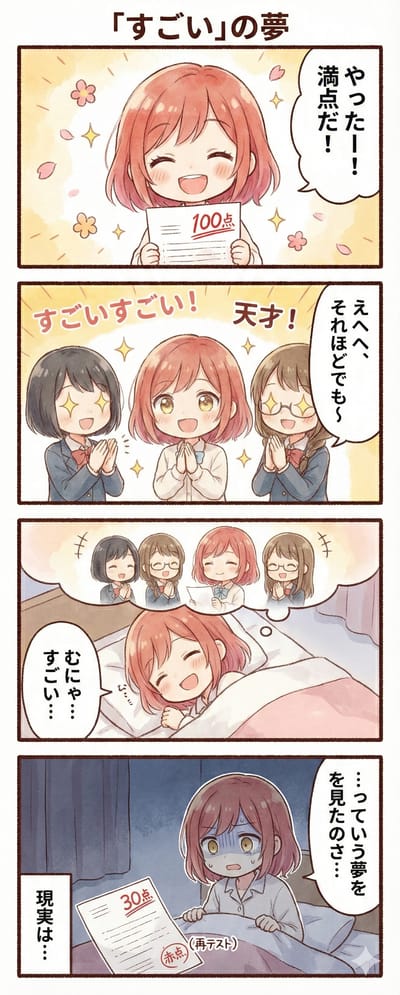
A short 4-panel comic shows situations where we rephrase “すごい.” Use it as a relaxed reading and speaking prompt.