Newer
Learning About Life in Japan Through Words (5) Why stay quiet on trains? — Learning consideration through language
03/11/2025
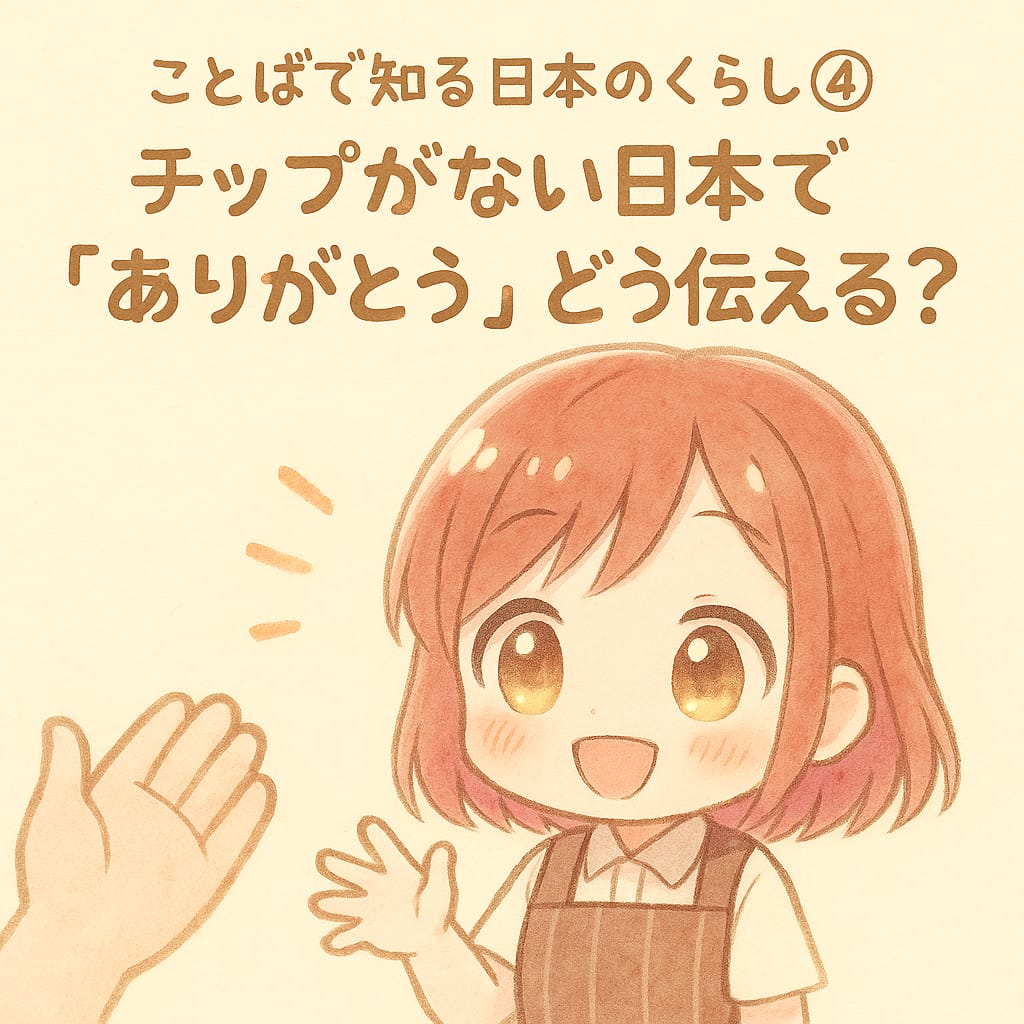
Many countries use tips as a “sign of thanks.” In Japan, there is no tipping custom. Even so, people express “thank you” with words and small actions in daily life.
This article explains why there is no tipping and teaches easy Japanese phrases for gratitude.
Common ways to say “thank you.” Try them in simple situations.
| Japanese | Reading (kana) | IPA | Meaning & usage |
|---|---|---|---|
| 「ありがとうございます」 | 「ありがとうございます」 | [aɾiɡatoː ɡozaimasɯ] | Most common polite thanks. Used for present or recent actions. |
| 「ありがとうございました」 | 「ありがとうございました」 | [aɾiɡatoː ɡozaimaɕita] | Thanks for something finished. Good when leaving a store. |
| 「ごちそうさまでした」 | 「ごちそうさまでした」 | [ɡotɕisoːsame deɕita] | After eating. For home or restaurants. |
| 「お世話になります」 | 「おせわになります」 | [osewa ninaɾimasɯ] | Before receiving help. Common at work or in procedures. |
| 「感謝申し上げます」 | 「かんしゃもうしあげます」 | [kaɴɕa moːɕiaɡemasɯ] | Very formal. Used in letters or speeches. |
IPA is the International Phonetic Alphabet. The vowel “う (ɯ)” can be weak in speech (for example, 「です」 ≈ [des]). We show basic forms for learning.
Instead of money, people use words to show gratitude. Phrases like 「ありがとうございます」 or 「ごちそうさまでした」 represent giving back with the heart.
Some feel that giving money makes it feel like a hired relationship. Gratitude is exchanged between equals, with words and attitude.
In a few hotels or tourist spots, a small “token” may appear, but it is not common. Start with words.
State clearly what you are thankful for. It feels warmer.
「〜てくれてありがとう」(Thank you for doing …)
| Sentence | Meaning |
|---|---|
| 「手伝ってくれてありがとう。」 | Thank you for helping me. |
| 「来てくれてありがとう。」 | Thank you for coming. |
| 「話してくれてありがとう。」 | Thank you for sharing your thoughts. |
It is close to “Thank you for doing …,” but in Japanese it often sounds more empathetic toward the action.
To be more polite, use 「〜てくださってありがとうございます」.
Turn these into 「〜てくれてありがとう」.
「〜てくれて」 shows that the person did something for you. It carries your warm feeling.
Words and small actions speak clearly, even without tips.
A small bow and a natural smile work well. Keep your voice considerate of others.
Next time: “Life in Japan Through Words (5)” Why are trains quiet? — Learn kindness through words