Newer
Two Number Systems in Japanese and Their Asian Roots
14/10/2025
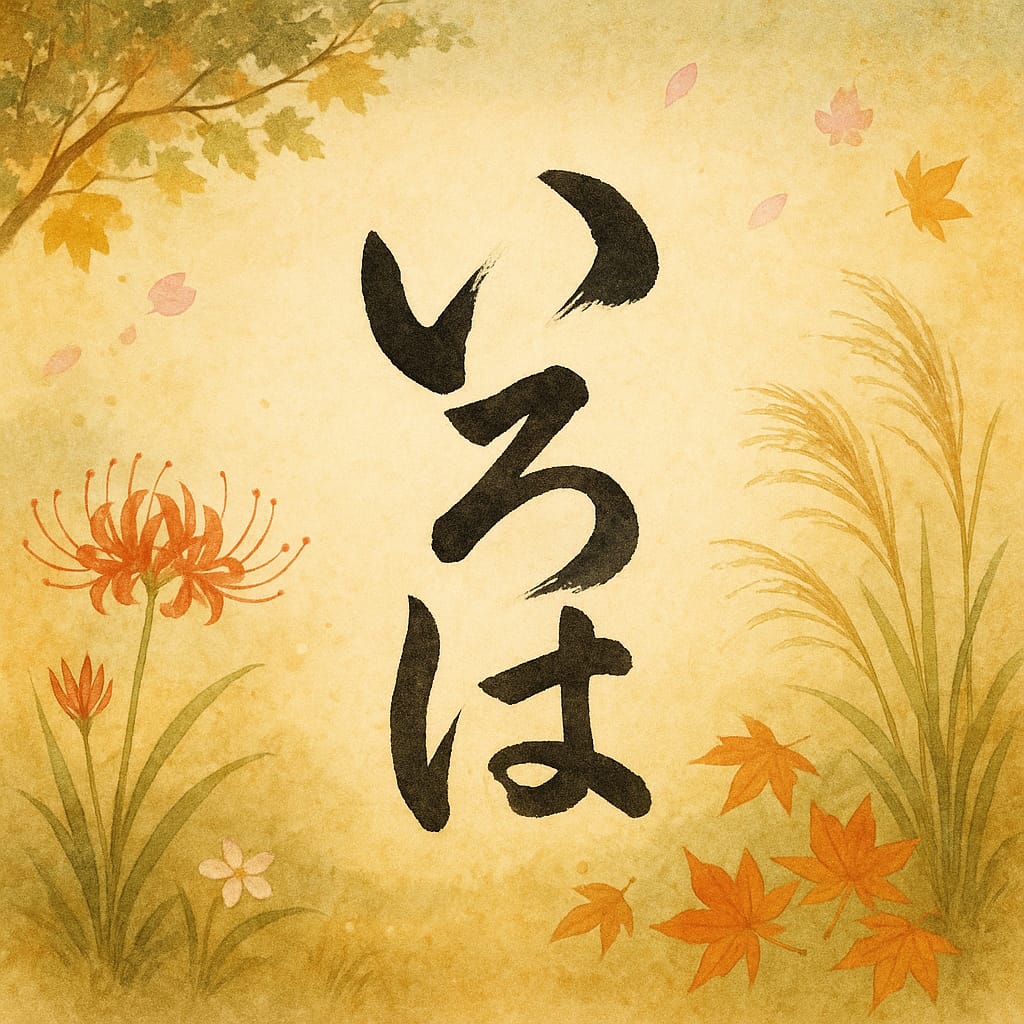
As summer fades in Japan, nights are starting to feel cool enough for a light jacket. Leaves begin to change colour, and the air grows quiet — with a touch of gentle solitude.
In this season when we feel “transition(移ろい)”, flowers bloom and then fall, and everything changes. From this autumn scene, let’s meet an old Japanese poem: 「いろは歌(いろはうた)」 (Iroha poem).
「いろは」 is not only an order of letters. It also carries the Japanese heart and a way of seeing life — expressed in beautiful, simple words.
In Japanese, 「いろは」 is a very old term. Before today’s “あ・い・う・え・お(a‑i‑u‑e‑o)” order existed, people used the sequence 「いろはにほへと……」 (iroha nihoheto …). This is called 「いろは順(いろはじゅん)」 (iroha order).
We use plain language throughout this article. Special historical terms are briefly explained later in “用語メモ(Glossary)”.
Letter order
→ Used to sort items in the sequence 「い・ろ・は・に・ほ・へ・と…」 (i‑ro‑ha‑ni‑ho‑he‑to…).
Old dictionaries and rankings also used this order.
The basics of something
→ As in 「いろはを学ぶ」 (learn the basics) or 「仕事のいろはを教える」 (teach the basics of a job).
It’s similar to English “ABC”.
「いろは」 also means “beginner’s basics(初歩・基本)”. In learning Japanese, 「〜のいろはを学ぶ」 means “learn the foundation of 〜”.
「いろは順」 is said to have formed in the Heian period. It grew out of the poem 「いろは歌(いろはうた)」 (Iroha), which contains every kana exactly once. Over time, the sequence came to be used for sorting as well.
Up to the Edo period and beyond, even official materials — dictionaries, documents, laws, and school lists — often used iroha order.
From the late Meiji era, the 「五十音順(ごじゅうおんじゅん)」 (gojūon order) spread widely. Because it arranges by pronunciation “あ・い・う・え・お(a‑i‑u‑e‑o)”, people found it easier to learn and to look things up.
After World War II, schools, dictionaries, and public offices mostly switched to gojūon order. Still, iroha order did not disappear completely.
Iroha order used to organise dictionaries and legal texts. Traces of it remain, for example in clause numbering.
You can still find iroha order in everyday life in Japan:
Law and clause numbering
Example: after 「第1条」「第2条」「第3条」 (Article 1, 2, 3),
you may see 「第3条のい」「第3条のろ」 etc.
This is a method to insert new clauses between existing ones.
Class or group names at school
Example: 「い組」「ろ組」「は組」 (Class i, ro, ha).
Old elementary schools often used this sequence for classes.
Music
Alongside “Do Re Mi”, Japanese pitch names are 「ハ・ニ・ホ・ヘ・ト・イ・ロ」 (Ha‑Ni‑Ho‑He‑To‑I‑Ro).
Terms like 「ハ長調」 (Ha major) come from this system.
This “イロハ” is still used together with solfège.1
Traditional charts and lists
Seen in sumo rankings, martial‑arts grades, and older dictionaries.
いろはにほへと ちりぬるを
(Even colourful flowers, though they bloom, will one day scatter.)わかよたれそ つねならむ
(In this world, no one remains the same forever.)うゐのおくやま けふこえて
(Today again, we cross a deep mountain of life.)あさきゆめみじ ゑひもせず
(Do not chase shallow dreams; do not be drunk with delusion.)
The original uses kana no longer common today: 「ゐ(wi)」 and 「ゑ(we)」. This reflects historical kana usage.
The Iroha is written entirely in kana, not kanji. It shows the unique writing culture of Japanese.
The Iroha uses every kana exactly once. It has long been used to help learners memorise Japanese characters.
Buddhism began in India, and spread across many parts of Asia.
Roughly speaking, there were two routes: one southward (to places like Sri Lanka and Thailand), and one northward (through China and the Korean Peninsula) to Japan.
What reached Japan is called 「大乗仏教(だいじょうぶっきょう)」 (Mahāyāna Buddhism). It values the teaching “let us live so that all people can be saved”.
In Japan, Buddhist ideas met nature and poetry, and were expressed in calm, beautiful language as in the Iroha.
The Iroha is a special poem in Japanese. Within its short lines lie views of life and a heart that Japanese culture has cherished.
At the core of the Iroha is 「無常(むじょう)」 (impermanence): everything changes; nothing stays the same forever.
花は咲(さ)いても、いつか散(ち)る。
(Flowers bloom, and still they will one day fall.)
人も生きて、やがて年をとり、亡(な)くなる。
(People live, grow old, and eventually pass away.)
この世(よ)のすべては、いつも少しずつ変わっています。
(All things in this world are always changing, little by little.)
This view traces back to Buddhism. In Mahāyāna as received in Japan, the teaching is “accept change and live the present with care”. That quiet heart is present in the Iroha.
The Iroha also says, “do not fear change(変化)”. Even if flowers fall, new ones bloom. Precisely because things end, we can treasure the present.
「今を生きる」
(Live this moment.)
This is a deeply valued idea in Japanese culture.
You can feel it in 「茶道(さどう)」 (sadō, tea ceremony) and 「俳句(はいく)」 (haiku) as well.
This spirit of 「調和(ちょうわ)」 (harmony) connects to a way of living that avoids conflict with people and nature and seeks balance.
The Iroha also teaches: “do not make yourself look great”. People change, and power or honour do not last long. Therefore we do what is before us with care, and live with gratitude.
「浅(あさ)き夢みじ、ゑひもせず」
(Do not indulge in shallow dreams, nor be intoxicated by delusion.)
This view influenced later Japanese literature and poetry, and even everyday greetings and ways of speaking.
The Buddhist ideas behind the Iroha are also cherished in many Asian countries — Thailand, China, Korea, Vietnam, Sri Lanka, Myanmar, and more. Teachings like “all things change” and “care for inner peace” are shared.
So for many learners in Asia, reading the Iroha may feel somehow familiar. Languages differ, but the heart’s root is shared.
Like the seasons turn, language and culture keep moving, little by little. This autumn, let the Iroha be a gentle way to taste Japanese language and culture.
Sorting by the sequence 「い・ろ・は・に・ほ・へ・と…」. Used in older dictionaries and rosters.
Sorting by pronunciation “あ・い・う・え・お”. The modern standard in schools and dictionaries.
A short poem that uses each of the 47 kana once. It conveys the idea of impermanence(無常) in gentle words.
The view that “everything changes”. It leads to the teaching to value the present moment.
A Buddhist tradition that values “the liberation of all”. It became widespread in Japan and shaped culture.
Living in balance without conflict with people or nature. Seen in arts like tea ceremony and haiku.
The pitch names 「ハ・ニ・ホ・ヘ・ト・イ・ロ」 are still used in music theory. In daily speech, “Do Re Mi” is more common. ↩